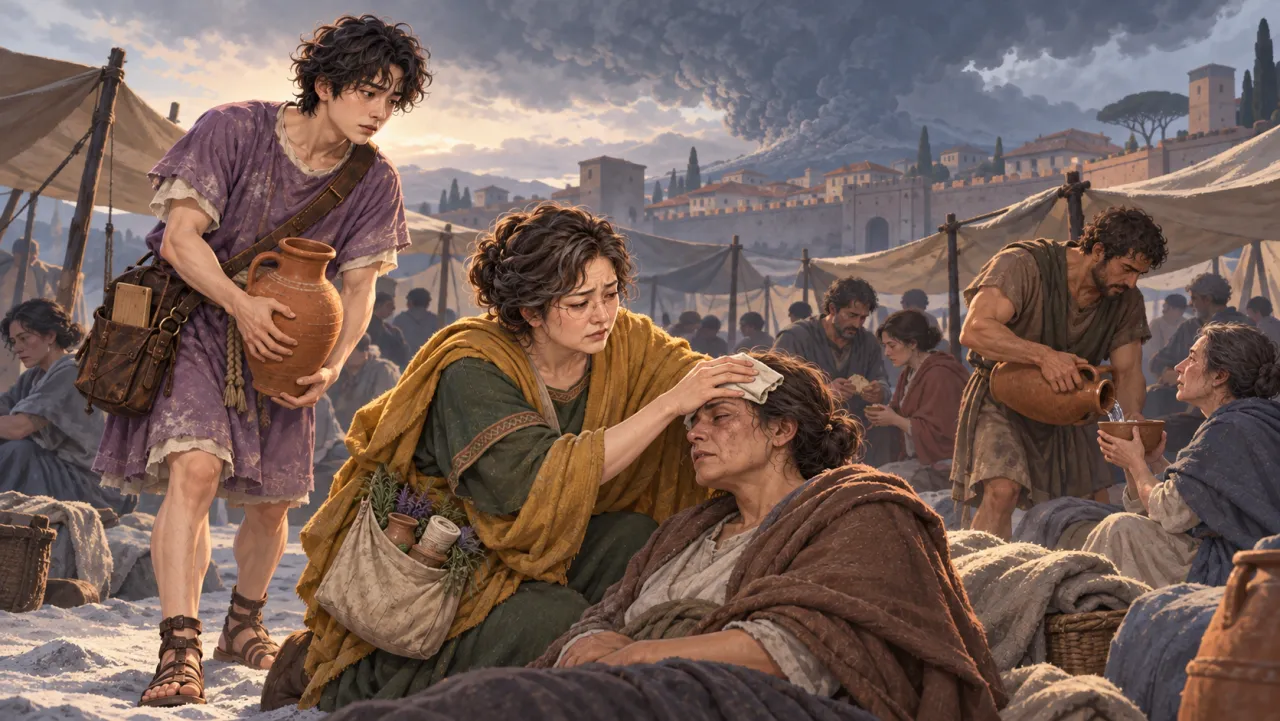
When a Volcano Erupts: Lessons from Pompeii and Today's Evacuation Advice
▶ Play free nowNo install · phone or PC · 3–4 minutes a runSurviving a volcanic eruption comes down to a few things. When warned, leave early and go far; when ash falls, cover your head, nose and mouth; don't stay under a roof loaded with ash; and don't go back until the authorities say it's safe. This guide is based on the US Geological Survey (USGS) Volcano Hazards Program, the International Volcanic Health Hazard Network (IVHHN), the Pan American Health Organization (PAHO), Italy's national emergency plan for Vesuvius, and historical records and research on Pompeii in AD 79. In a real emergency, always follow your local authorities first.
1. What happened at Pompeii in AD 79
- There had been earthquakes for days, but they caused little alarm because they were “common in Campania” (Pliny the Younger, letter 6.20). People did not know Vesuvius was a volcano.
- Around 1 p.m. an umbrella-pine-shaped column rose (6.16). Pumice fell on Pompeii at about 15 cm an hour, piling up to about 2.8 m by the next morning (Sigurdsson et al. 1985; Pompeii Archaeological Park).
- About 38% of the known victims died when roofs and walls collapsed under the pumice (Luongo et al. 2003); from about 6:30 the next morning, pyroclastic surges swept over the walls and buried the town.
- Remains of more than 1,100 victims have been found. Italy's Ministry of Culture estimates the dead at no less than 15–20% of the population — most of those who left early survived.
- In the boat sheds on the beach at Herculaneum, the remains of about 300 people who were waiting for rescue by sea were found (Herculaneum Archaeological Park).
2. Before an eruption: evacuate when warned
- Today observatories monitor earthquakes, ground swelling and gas, and issue alert levels. If an evacuation order comes, follow it without delay.
- Around Vesuvius, preventive evacuation of the “red zone” within 72 hours before an eruption is the only protective measure, because buildings cannot withstand pyroclastic flows (Italian Civil Protection Department).
- Keep water, a well-fitting dust mask (such as an N95), goggles, a flashlight, a radio and essential medicines in an emergency bag.
3. Pyroclastic flows: you cannot outrun them
- Pyroclastic flows are mixtures of hot gas and volcanic debris that typically race down slopes at more than 80 km/h (50 mph), at 200–700 °C (USGS). Leaving before they come is the only way.
- They usually follow valleys. When evacuating, avoid valley floors and riverbeds and keep to higher ground.
- In AD 79 the surges came one after another. The first cloud passing does not mean it is over.
4. When ash is falling
- Cover your nose and mouth firmly with a mask or cloth and protect your eyes with goggles. Wetting a cloth or mask does not make it filter ash better (PAHO/IVHHN); a well-fitting dust mask is best.
- While ash is falling, stay indoors until the authorities say it is safe (as long as the roof can bear the load), with doors and windows closed. Avoid driving — ash cuts visibility and makes roads slippery (USGS).
- If stones are falling too, protect your head with a helmet. In AD 79 at Stabiae, people went out “with pillows tied on their heads with cloths” (Pliny, 6.16).
- In ash, breathe slowly and evenly. Gasping pulls in more ash.
5. Ash on the roof: before it collapses
- Weaker roofs (flat, long-span or non-engineered) can collapse under ash about 10 cm or more, and wet ash can weigh up to twice as much (USGS).
- Clearing thin ash early helps, but ash-covered roofs are slippery and may already be at their load limit. Use boards, work carefully with others, and don't climb up alone without training. Climbing a heavily loaded roof while ash keeps falling is dangerous (USGS/IVHHN).
- If beams groan or dust trickles from the ceiling, get out from under it at once — before doors are blocked by ash and stones.
6. Volcanic gas and low ground
- Gases such as carbon dioxide are heavier than air and collect in hollows, ditches and basements. If you smell sulphur or get a headache, move to higher, breezy ground (USGS).
- However tired you are, don't lie down in low places.
7. The sea and the shore
- Strong earthquakes during an eruption can make the sea suddenly withdraw and then rush back. At Misenum, Pliny the Younger saw “the sea drawn back” (6.20). If the water pulls back, don't watch — move away from the shore to high ground.
- Boats can be blocked by wind, waves and floating pumice. Don't wait on the beach for a boat that isn't coming.
8. Darkness and rumours
- When an ash cloud covers the sky, day can turn pitch-black. Keep your light, move as one line with your group and call out names.
- “There are no more gods”, “this night will last forever” — despair and false rumours spread through the crowd at Misenum (6.20). Today, check official channels: authorities, observatories, broadcasts.
- Don't go back because someone says “it has calmed down”. Wait until the authorities say it is safe.
9. Beliefs of the age vs what we know now
- Then: “Offerings at the temple will calm the mountain” → Now: eruptions are driven by magma; waiting costs the time you need to leave.
- Then: “Hide in the strongest room and it will pass” → Now: roofs loaded with ash and pumice collapse. Near a volcano, leave early and go far.
- Then: “Take the gold so you can start again” → Now: heavy bags slow you down. Water, a mask, a light — and people.
- Then: “The stones have stopped, let's go home” → Now: worse can come next.
To live these lessons yourself, see the Pompeii survival game guide.
FAQ
What should I do first when a volcano erupts?
Follow official evacuation orders and leave early, away from the volcano. Pyroclastic flows can't be outrun, so leaving before they come is the only way.
What should I do when volcanic ash is falling?
Cover your nose and mouth firmly with a mask or cloth and protect your eyes with goggles. Stay indoors with doors and windows closed while the roof can bear the load, and avoid driving.
Does a wet cloth filter volcanic ash better?
No. PAHO and IVHHN advise that wetting a cloth or mask does not improve filtration. A well-fitting dust mask is best.
Should I clear ash from my roof?
Clearing thin ash before it builds up helps, but ash-covered roofs are slippery and may be at their load limit, so be very careful. Weaker roofs can collapse under about 10 cm of ash, and wet ash can weigh up to twice as much.
What is a pyroclastic flow?
A fast-moving mixture of hot gas and volcanic debris that pours down a volcano's slopes, typically at more than 80 km/h and 200–700 °C, usually following valleys (USGS).
How did the people of Pompeii die?
About 38% of the known victims died when roofs and walls collapsed under the pumice; most of the rest died in the pyroclastic surges the next morning. Most residents who left early survived.
Is Vesuvius still dangerous?
Vesuvius is still an active volcano, and Italy has a national emergency plan to evacuate the surrounding “red zone” before an eruption.
Is this official guidance?
No. It's an educational summary of official sources and historical records. In a real emergency, follow your local authorities' latest official guidance.