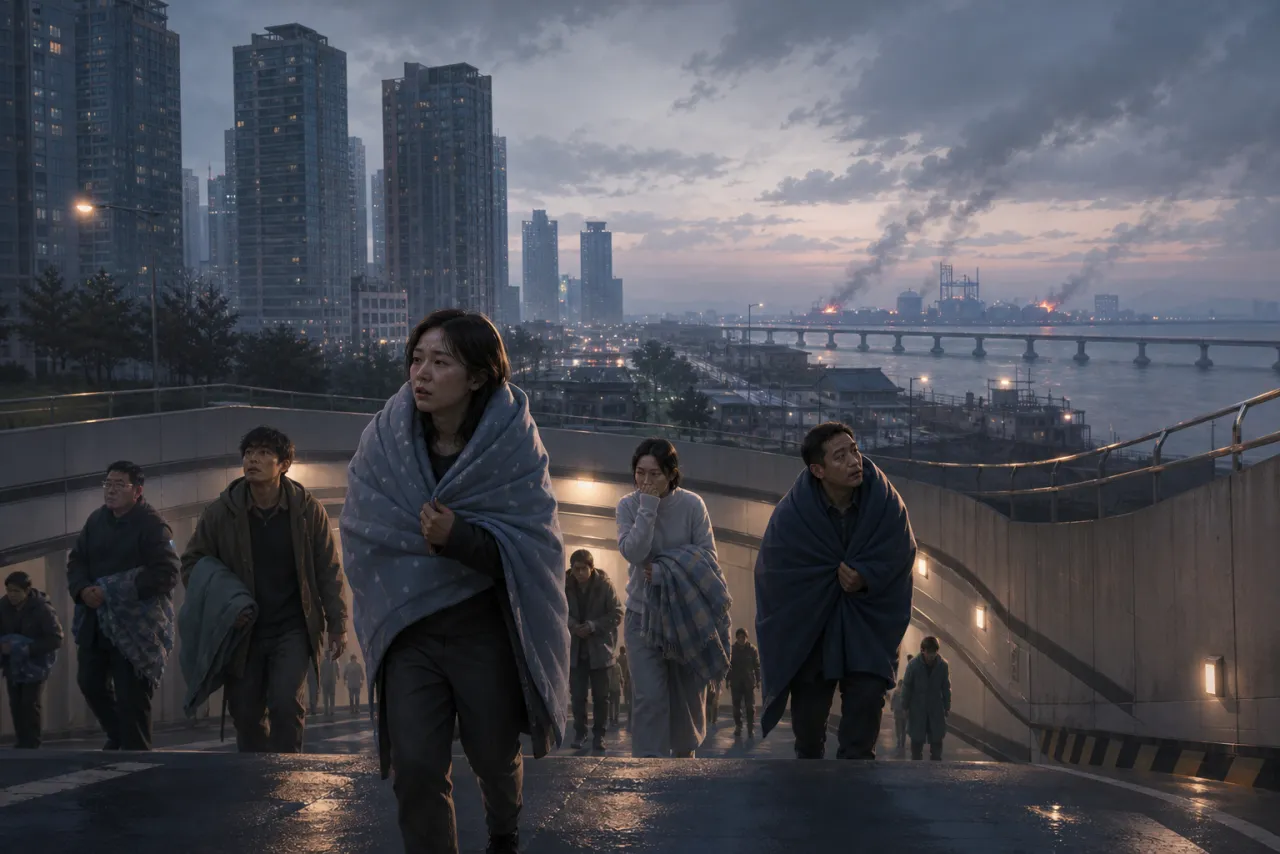
What to Do in a Drone Attack or Air Raid, and an Emergency Go-Bag Checklist
▶ PLAY FREE NOWNo download · Phone or PC · 3–5 minutes per run · 10 languagesKorea has no separate civilian guidance just for drone attacks; drone attacks follow the air-raid alert guidelines. This page is based on the civil-defense guidelines on the National Disaster Safety Portal of Korea's Ministry of the Interior and Safety, with advice added from the State Emergency Service of Ukraine (DSNS) and Israel Home Front Command, which deal with real drone attacks.
1. When the air-raid alert sounds: go to the nearest civil-defense shelter (underground)
- Move immediately to the nearest civil-defense shelter. Many apartment parking garages, subway stations and underground shopping arcades are designated.
- If you can't reach a shelter, go to an underground parking garage or deep inside a windowless concrete building.
- In high-rises, use the emergency stairs instead of the elevator in case of a blackout.
- Once sheltered, listen to and follow government guidance on radio, TV and Emergency Alerts.
- If you are driving, pull over to the right side of the road and take shelter in the nearest underground space. When everyone rushes for bridges and main roads, the cars stop moving.
Finding a shelter: in Korea, search “민방위 대피소” (civil-defense shelter) in the Safety Dimdol app, the National Disaster Safety Portal, or map apps such as Naver Map, KakaoMap and T map. Elsewhere, check your local authority's shelter information. Know the shelters near your home, work and the places you often go in advance.
2. When you can't reach a shelter: the two-wall rule
The State Emergency Service of Ukraine stresses that the shelter comes first. Only when you can't reach one, the fallback is to stay in a windowless corridor, toilet or bathroom with two walls between you and the outside. It won't survive a direct hit, so “two walls” does not replace a shelter.
- Stay away from windows, balconies, glass doors and large mirrors; sit or lie on the floor. Most people hurt by a nearby blast are hit by flying glass.
- Basements and machine rooms not set up as shelters can be dangerous because of pipes, gas lines and cables.
- Don't hide in an elevator. In a blackout, you'll be trapped between floors.
3. When the drone sound is close
- Immediately drop and cover your head with your arms. Don't stand and watch or film.
- Don't film attacks, air defense or damage and post them on social media (Security Service of Ukraine advisory). Standing at a window or on a rooftop to film is dangerous in itself.
- Israel Home Front Command: drone incursions can happen without warning. When an alert comes, enter a protected space and stay there until further instructions.
4. Blackouts, gas smells and elevators
- Gas smell: no lighters, matches, electrical switches or fans. Shut the valve, open windows to ventilate, then call 119 or the Korea Gas Safety Corporation from outside.
- Stuck in an elevator: don't force the door; use the emergency bell or intercom and wait (National Fire Agency).
- Blackout: a phone flashlight drains the battery fast. Keep a separate flashlight and power bank. Send family short texts instead of calling.
5. Official guidance over rumors; stay until the all-clear
Don't spread unsourced messages like “○○ fired it” or “all of Songdo will blow, get out over the bridge.” Don't leave the shelter before the official all-clear. “They say it's over” is not an all-clear. Even after the all-clear, don't touch fallen debris or unexploded objects; report them to 112 or 119.
6. Emergency go-bag checklist
When the power and network go down, card payments, apps and your phone flashlight won't last long. One go-bag by the front door, ready to grab, changes the night.
- Water: 3 L per person per day × at least 3 days (72 hours) — about 36 L for a family of four. 1–2 bottles in the bag, the rest stored at home.
- Emergency food: 3 days of no-cook food such as energy bars, canned food and ready meals.
- A flashlight with spare batteries, and a battery or wind-up portable radio.
- A power bank (fully charged) and charging cable.
- First-aid kit and medicines (a few days of your regular medication), masks.
- Cash (small bills), copies of your ID and insurance card, a note of family contacts.
- A whistle, a foil blanket, wet wipes, a portable toilet and plastic bags.
7. A 72-hour supply: emergency food and water
The UK government (Prepare) recommends every household be ready to last three days (72 hours) — 3 L of water per person per day, no-cook food, a wind-up or battery radio, a flashlight and cash. The Japanese government recommends stockpiling for at least 3 days, ideally a week. The State Emergency Service of Ukraine advises keeping an emergency bag with document copies, cash, medicine, water, food, a flashlight and a power bank near the door. Rather than panic-buying, build it up a little each time you shop.
Practice with the simulation
Reading a list is different from remembering it amid sirens. Songdo: The Drones Are Coming is a free browser game where you make these decisions yourself, against the clock (the attacker, facilities and characters are fictional). See the game guide.
Sources
- Ministry of the Interior and Safety (Korea), National Disaster Safety Portal — civil-defense air-raid guidelines, emergency supplies, finding civil-defense shelters (Safety Dimdol)
- State Emergency Service of Ukraine (DSNS) — shelter first, the two-wall rule, emergency bag advice
- Security Service of Ukraine (SBU) — advisory against filming and posting attacks
- Israel Home Front Command — on hostile aircraft intrusion alerts, enter a protected space and wait for further instructions
- National Fire Agency (Korea) — what to do when trapped in an elevator
- Korea Gas Safety Corporation · Incheon City — what to do in a gas leak
- UK government Prepare (Be Ready) — 72-hour emergency kit
- Cabinet Office of Japan — stockpile at least 3 days, ideally 1 week
This page is general educational information, not official government guidance. In a real emergency, follow Emergency Alerts and the instructions of your government and local authorities.
FAQ
Where should I shelter during a drone attack?
Follow the air-raid alert guidelines. Go to the nearest civil-defense shelter (underground parking garage, subway station, etc.); if you can't, go deep inside a windowless concrete building. In high-rises, use the emergency stairs instead of the elevator.
How do I find a civil-defense shelter?
In Korea, search '민방위 대피소' (civil-defense shelter) in the Safety Dimdol app, the National Disaster Safety Portal, or Naver Map, KakaoMap or T map. Check the shelters near your home and workplace in advance.
What is the two-wall rule?
A fallback for when you can't reach a shelter: stay in a windowless corridor or bathroom with two walls between you and the outside. It won't survive a direct hit, so a shelter comes first.
What goes in an emergency go-bag?
Water (3 L per person per day), 3 days of emergency food, a flashlight, a portable radio, a power bank, a first-aid kit and medicines, masks, cash, ID copies, a whistle and a foil blanket.
How much should a 72-hour kit include?
The basics are 3 L of water per person per day × 3 days (9 L) and 3 days of no-cook food. The Japanese government recommends a week's supply if possible.
What should I do if I smell gas?
Don't use lighters, electrical switches or fans. Shut the valve, open windows to ventilate, and call 119 or the Korea Gas Safety Corporation from outside.
How do I know the all-clear has been given?
It is announced by Emergency Alerts and government broadcasts on radio and TV. Someone nearby saying 'they say it's over' is not an all-clear. Stay in the shelter until the official announcement.